
You can place a listing, open house, or contact message on local digital billboards without committing to a long media contract. With programmatic DOOH, you select screens, locations, timing, and budget through software, making real estate billboard advertising more accessible to agents, Realtors, and smaller teams.
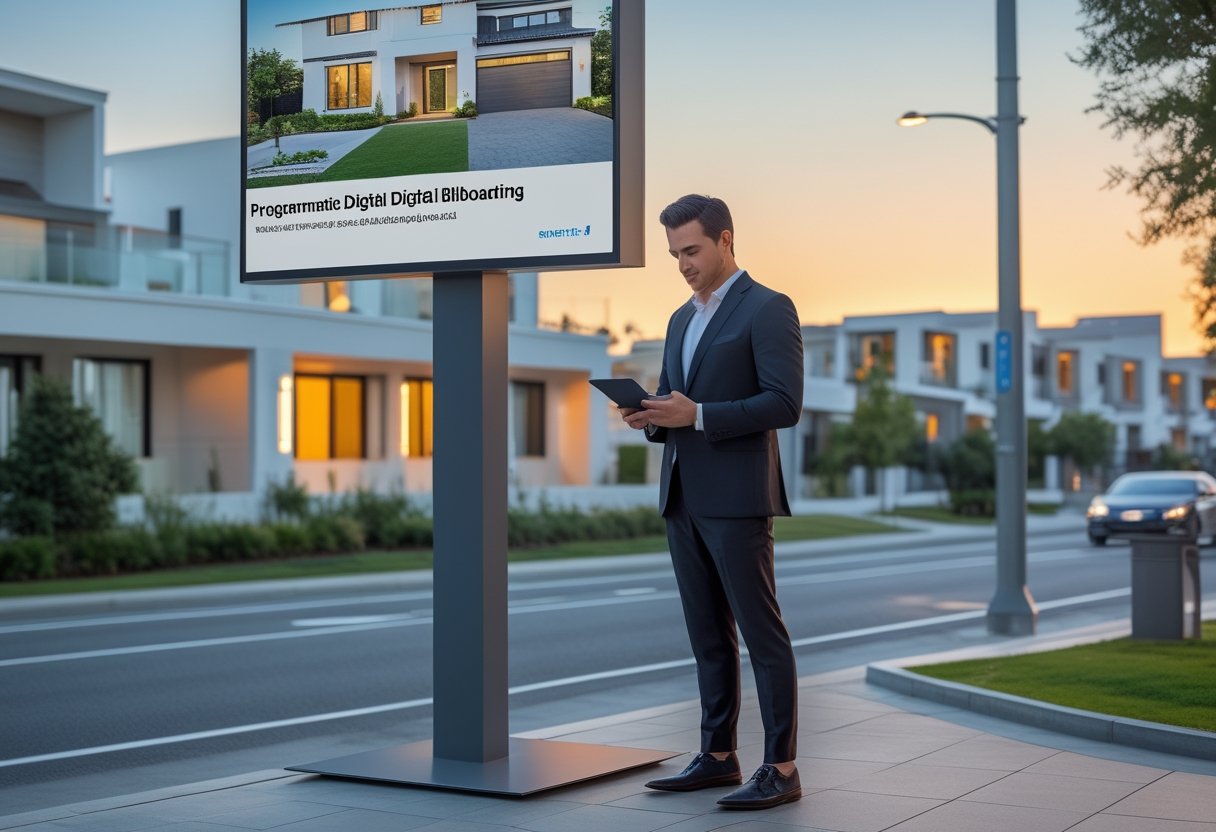
You can test local visibility with a controlled campaign starting at $10 a day, measure its performance, and adjust your message or targeting without buying a fixed billboard schedule. This approach supports brand awareness while your listing competes for attention in a changing real estate market.
You’ll learn how programmatic advertising delivers listings to digital out-of-home (DOOH) screens, how to build a practical $10-per-day campaign, and which metrics help you improve results.
How Programmatic Digital Billboards Work for Local Listings
Programmatic digital billboards let you buy screen time through software instead of negotiating separately with each outdoor advertising company. You set the budget, schedule, location, audience criteria, and creative, while the platform matches your campaign with available ad inventory and delivers your real estate ads to selected digital screens.
From Ad Inventory to Screen Delivery
A programmatic DOOH platform connects your campaign with ad inventory from multiple digital billboard and screen operators. You typically choose a market, radius, screen type, time window, budget, and buying method before submitting your creative.
The platform evaluates available ad placements as they become eligible. When a screen has an open advertising slot, the system can place your ad according to your campaign settings. Your listing may appear on roadside billboards, transit displays, retail screens, or other permitted outdoor advertising locations.
You usually pay for delivered impressions or scheduled plays rather than signing a long-term billboard contract. A $10 daily budget may provide limited delivery, depending on the market, screen supply, pricing, and campaign settings, so you should treat the amount as a starting budget rather than a guaranteed number of views.
Some platforms let you adjust the budget, schedule, locations, or creative while the campaign runs. This flexibility distinguishes programmatic digital billboard buying from manual billboard advertising, where changes often require a new agreement or production cycle.
Audience Targeting With Location and Demographic Data
Your targeting can combine screen location with audience signals. A campaign might focus on screens near a listing, commuter routes, retail districts, business centers, or neighborhoods where likely buyers spend time.
Platforms may use mobile location data and other aggregated signals to estimate patterns such as visits, travel routes, dwell areas, and audience composition. Demographic data can support audience segmentation by factors such as age range, household characteristics, income estimates, or consumer interests, where the platform makes those categories available.
For example, you could target screens within several miles of a condominium, prioritize evening commuter traffic, and add an audience segment associated with homebuying or relocation. This does not identify individual people or guarantee that a viewer wants your property. It helps you select environments where your intended audience is more likely to see the ad.
Use custom audience segmentation carefully. A narrow audience may improve relevance but reduce delivery, while broader location targeting may produce more impressions at a lower cost. Automated DOOH buying works best when you balance audience quality, screen availability, budget, and campaign duration.
Dynamic Creative for Listings, Condos, and Commercial Properties
Dynamic creative lets you adapt a real estate ad to the screen, time, location, or available listing data. You can create different versions for a downtown condo, suburban home, apartment building, or commercial property without manually scheduling every variation.
A residential listing might show the property photo, price, neighborhood, bedroom count, and a short call to action. A condo campaign could display “New downtown condos” near a central business district, while a commercial property ad could emphasize square footage, lease availability, zoning, or proximity to major roads.
You should design for quick outdoor viewing. Use one strong image, large readable text, a short URL or QR code, your name or brokerage, and one clear action such as Book a showing or View available units. Keep critical information visible for the entire ad duration.
Dynamic creative can also respond to conditions such as time of day or location. For instance, you might promote an open house during nearby weekend hours and switch to a general property message afterward. Platforms such as programmatic OOH systems can use campaign rules to match variations with eligible digital screens.
How pDOOH Differs From Traditional Outdoor Advertising
Traditional outdoor advertising usually involves selecting a specific billboard, agreeing to a fixed period, approving production, and committing to a defined placement. That approach can work for broad awareness, but it may provide less flexibility when your listing, price, or availability changes.
pDOOH uses software to buy digital out-of-home inventory across participating screens. You can set campaign rules, control spending, schedule delivery, and update creative without replacing a printed billboard. The system may also use location data and audience information to prioritize relevant screens.
Programmatic advertising does not make every screen available. Inventory depends on the operator, market, screen technology, approved content, and available time slots. Real estate ads may also need to follow platform policies and applicable housing advertising rules.
You should compare delivery reports with practical results. Track impressions, QR scans, landing-page visits, inquiries, showing requests, and calls, then adjust locations or creative. Unlike online ads, DOOH usually does not identify which specific person saw the billboard, so measurement often relies on aggregated exposure and response data.
Building, Measuring, and Optimizing a $10-Per-Day Campaign
A $10 daily budget works best when you limit geographic reach, match screens to listing activity, and measure each step from impression to closed-client opportunity. Your creative, landing page, tracking setup, follow-up process, and compliance controls must work together.
Choosing Screens and Setting Budget Allocation
Start with screens near the listing, major commuter routes, grocery centers, employers, open-house locations, and neighborhoods where your target buyers or sellers spend time. Prioritize digital billboards that provide clear audience, location, scheduling, and impression estimates instead of selecting inventory based only on traffic volume.
At $10 per day, avoid spreading spend across too many screens. Test one local cluster for 7–14 days, then compare delivery and lead quality before expanding. A practical allocation might reserve 70% for screen delivery, 20% for creative or landing-page testing, and 10% for retargeting or paid search when your platform supports those options.
Use outdoor advertising to reinforce your broader real estate digital marketing strategy, not to replace listing portals, Google Ads, Facebook Ads, PPC, or organic visibility. Ask the provider whether the budget includes production, minimum spends, impression reporting, and contract commitments.
Creating Clear Ad Creatives and Landing Pages
Design for rapid viewing. Show one property, one benefit, one location, and one action. Use a large property image, readable price or property type when appropriate, agent name, recognizable branding, and a short URL or QR code. Avoid paragraphs, small disclaimers, and multiple competing calls to action.
Your landing page should match the billboard exactly. Include the property address or neighborhood, several useful photos, key features, showing instructions, a short form, click-to-call functionality, and a clear privacy notice. Route submissions into your CRM so automated lead capturing records the campaign, screen location, creative version, and date.
Use separate tracking links for each screen cluster and creative. Run simple ad creative optimization tests, such as property-focused imagery versus neighborhood-focused imagery, while keeping the call to action consistent.
Connecting Outdoor Exposure to Search, Retargeting, and Follow-Up
Outdoor exposure often influences people before they search for your name or property. Use a memorable campaign URL, consistent agent branding, and a distinct phone number when practical. Monitor increases in branded searches, direct visits, calls, map activity, and visits to the listing page during the campaign period.
Connect the landing page to Google Analytics or another analytics platform, Google Ads, and your CRM. Visitors who consent to tracking can enter carefully configured retargeting campaigns, while first-party data from forms, calls, and saved contacts supports later follow-up. Do not treat every visitor as a sales-ready lead.
Create follow-up sequences based on intent. A property inquiry might receive immediate showing options, while a neighborhood guide download might receive market updates and seller information. Map user behavior—such as page views, form starts, return visits, and call clicks—so you can distinguish inbound leads from low-intent traffic.
Tracking Impressions, Clicks, Leads, and Return on Investment
Request a report that separates served impressions, estimated reach, QR scans, landing-page sessions, calls, form submissions, qualified leads, and appointments. Impressions indicate delivery, not individual exposure or intent. Compare the screen provider’s figures with your analytics data, recognizing that QR scans and web sessions will not match perfectly.
Use campaign-specific URLs, UTM parameters, unique phone numbers, and CRM fields. Track:
- Click-through rate: clicks divided by measured impressions
- Conversion rate: leads divided by landing-page sessions
- Cost per lead: campaign spend divided by leads
- Qualified-lead rate: qualified leads divided by total leads
- Return on investment: attributable profit compared with campaign cost
Allow enough time for meaningful comparisons, then adjust one variable at a time. If impressions are strong but scans remain weak, revise the creative or call to action. If clicks occur but forms do not, improve the landing page. Compare results with other channels, including programmatic campaign optimization practices, rather than judging outdoor media by clicks alone.
Compliance and Fair Housing Considerations
Apply the Fair Housing Act to the billboard, landing page, audience settings, and follow-up messages. Do not express preferences or exclusions based on protected characteristics, and avoid language that implies a neighborhood suits only a particular type of person or family. Describe property features, location, price, services, and objective eligibility requirements instead.
Review every creative and targeting plan under your brokerage’s policies and applicable state rules. The National Association of Realtors (NAR) provides professional guidance, but you still need to follow federal, state, local, platform, and MLS requirements. Confirm that listing photos, logos, testimonials, and property details have proper authorization.
Keep records of approvals, run dates, screen locations, targeting settings, disclosures, and lead handling. Obtain required consent for text messages, calls, email, cookies, and retargeting. Your CRM should preserve opt-outs and prevent follow-up that conflicts with a prospect’s stated preferences.